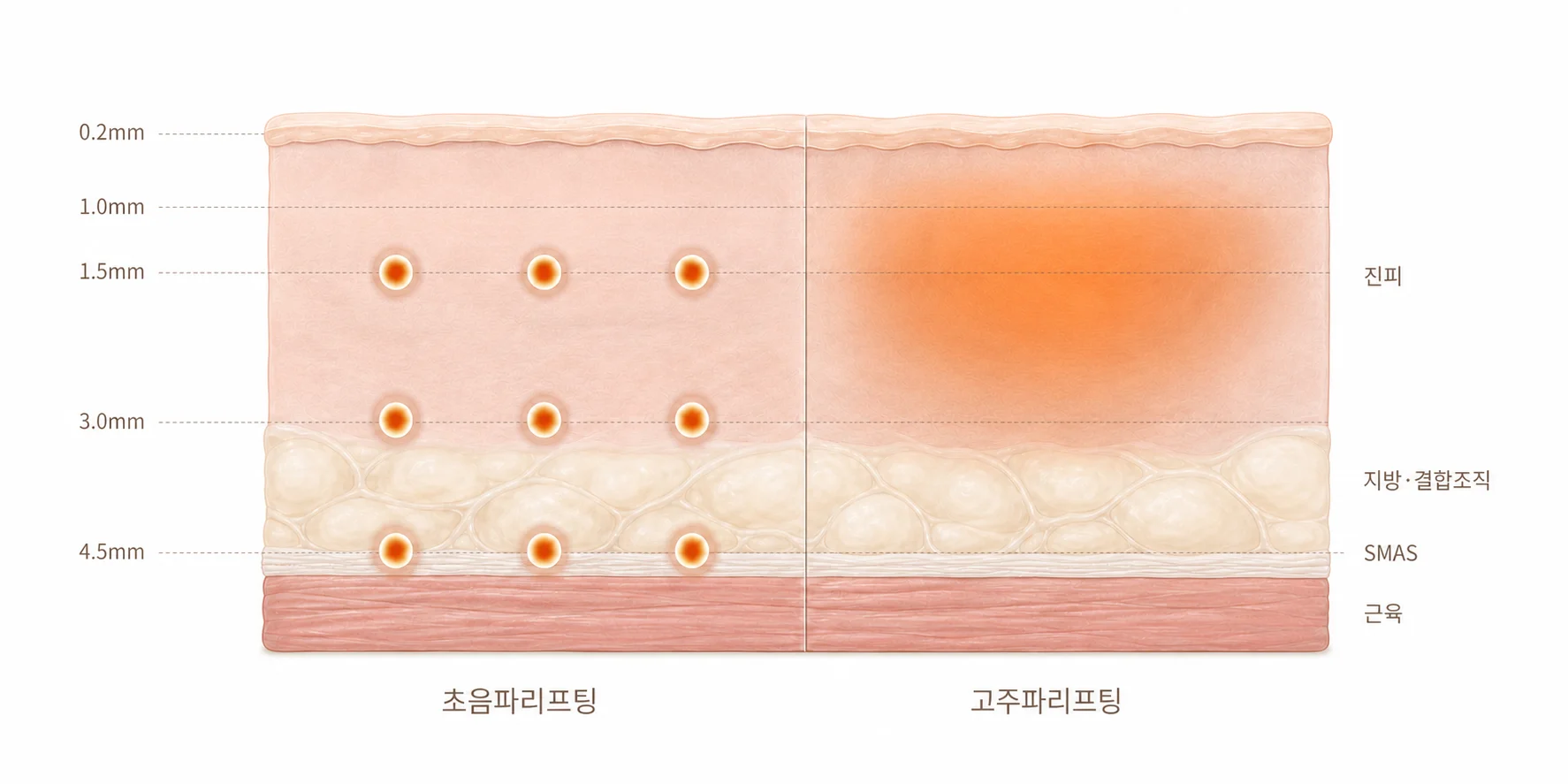
Ultrasound is focused on a single point and sent down to the SMAS (the fascial layer). It contracts the layer that supports the face, lifting sagging tissue upward.
Ulthera vs Thermage
Ulthera and Thermage,
how are they
different
These are the first two names you meet when looking into lifting treatments. They may seem like similar procedures with different names, but the two devices differ in both the type of energy and the skin layer they reach .
So the deciding factor is not which device is better, but which one suits your particular concern .

In One Line
Summed up in one sentence,
it is a difference of
depth
and
coverage
Ulthera delivers heat narrowly and deeply; Thermage delivers it broadly and evenly. This difference is what sets the two treatments apart in how they are used.
Radiofrequency heat is spread across the entire dermis. It increases the density of the skin itself, tightening lax skin overall.
How Energy Travels
The way the energy reaches the skin
is different
On the left is ultrasound (Ulthera); on the right is radiofrequency (Thermage). Ultrasound creates point-shaped thermal coagulation zones at set depths, while radiofrequency spreads broadly across the layers.
Each Device
Looking at the two devices
one at a time
Ulthera - lifts the supporting layer
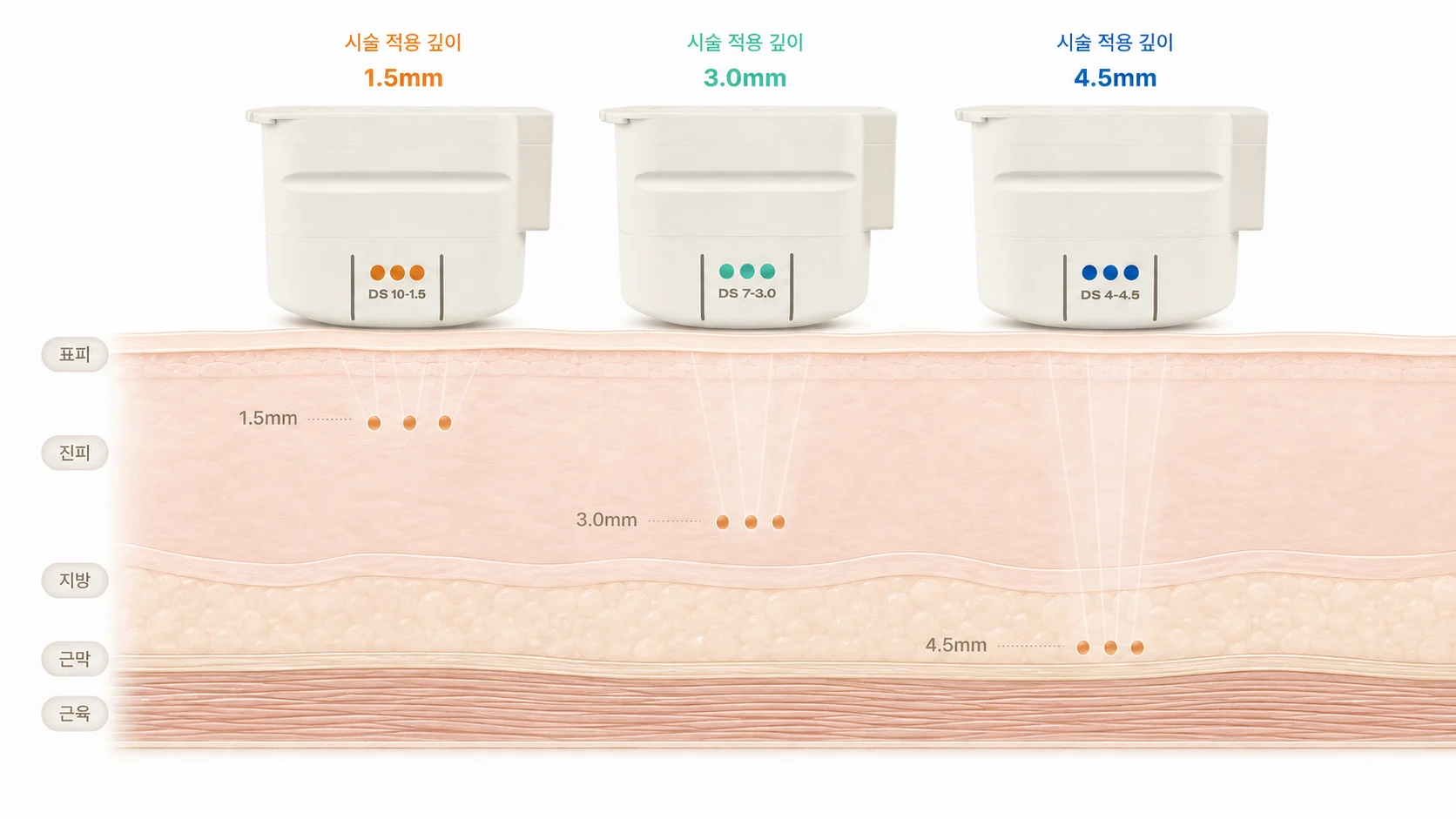
Using high-intensity focused ultrasound (HIFU), it creates thermal coagulation points in the SMAS (fascial layer) beneath the skin. The SMAS is the very layer that is pulled upward in surgical facelifts, and Ulthera's key strength is reaching this layer without an incision.
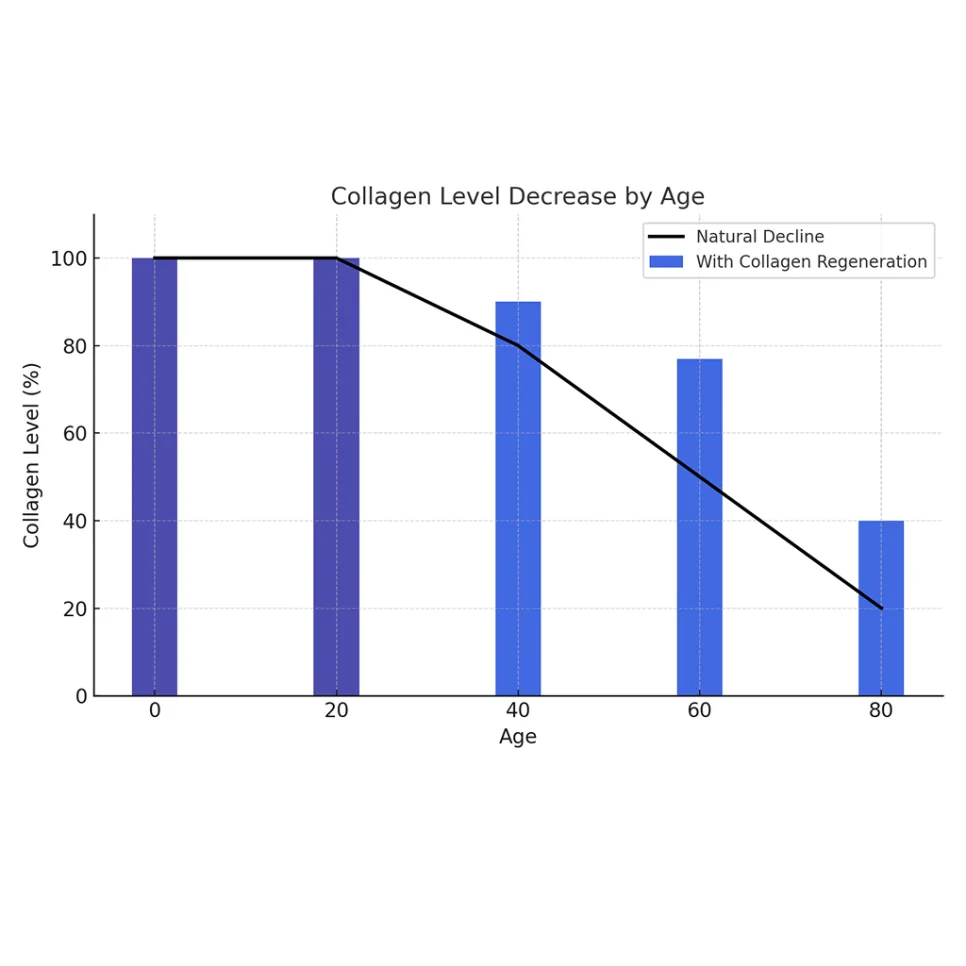
As the tissue contracts, an immediate tightening effect appears, and as collagen regenerates, the contours gradually refine over the following months.
- Energy High-intensity focused ultrasound (HIFU/MFU)
- Depth reached 1.5 · 3.0 · 4.5mm - from the epidermis down to the SMAS
- Main effects Lifting of sagging tissue, refining the jawline and facial contours
Thermage - tightens the skin
Radiofrequency (RF) energy is delivered broadly into the dermal layer, contracting existing collagen and stimulating new collagen production. It raises the density and elasticity of the skin itself without damaging the surface.
Because it covers a wide area evenly, it shows its strengths when the concern is laxity, fine lines, and skin texture rather than sagging. Lumiin is equipped with both Thermage FLX (4th generation) and Thermage CPT, choosing between them according to skin condition.
- Energy Radiofrequency (RF)
- Coverage Broad diffusion across the entire dermis
- Main effects Skin tightening, improvement of fine lines and skin texture
Side by Side
A side-by-side comparison
| Comparison | Ulthera | Thermage |
|---|---|---|
| Energy | High-intensity focused ultrasound (HIFU) | Radiofrequency (RF) |
| Delivery | Focused on a single point to create thermal coagulation zones | Heat spread evenly over a wide area |
| Main target layer | Down to the SMAS (fascial layer) - up to 4.5mm | The entire dermis |
| Main effect | Lifting that raises sagging tissue | Tightening that firms the skin |
| Best-suited concerns | A blurred jawline, sagging cheeks, softened contours | Lax skin, fine lines, rough skin texture |
| Onset of results | A slight tightening right after treatment → results build gradually over 2~3 months as collagen regenerates | |
| Sensation | Momentary pain when the deep layers are reached | A hot sensation spreading over a wide area |
※ This table summarizes the general characteristics of the two treatments; actual results and duration vary by individual depending on skin condition, age, and the extent and intensity of treatment.
Which One
So which one
is right
for me
Think about what catches your eye first when you look in the mirror. Below are the criteria that come up most often in consultations.
- Your jawline has blurred and feels like it is drooping
- Your cheeks have settled downward and your nasolabial folds have deepened
- You want to refine your facial contours themselves
- Your skin is on the thicker side and sagging is your main concern
- More than sagging, your skin feels thinner and lax
- Fine lines around the eyes and forehead bother you
- You want to refine pores and skin texture at the same time
- You want the whole face evenly firmer
Many patients receive both. Because they reach different layers, they do not interfere with each other's effects — the deep layers are supported with Ulthera while the surface is tightened with Thermage, each complementing the other. However, rather than having them back to back on the same day, it is safer to space them out while monitoring recovery; the order and interval are decided in consultation based on your skin condition.
Related
Guides worth reading together
Principle
How lifting works and
how results compare Ulthera Ulthera
device guide Oligio Oligio
device guide
how results compare Ulthera Ulthera
device guide Oligio Oligio
device guide
※ Treatment results may vary from person to person, and side effects may occur. Please consult a specialist thoroughly before treatment.
Begin Your Skin Journey
Which one is right for you?
Find out through a consultation
An accurate choice requires examining your skin thickness and degree of sagging in person. We will guide you through a one-on-one consultation.
02-565-8273 Book a Consultation ↗
3F SH Tower, 324 Seolleung-ro, Gangnam-gu, Seoul · 3 min from Hanti Station · 6 min from Seolleung Station
Weekdays
10:00–20:00
(lunch 13:00–14:00) · Sat
09:30–15:30
open through lunch
Closed on Sundays and public holidays
Equipment
이 진료에 함께 쓰는 장비
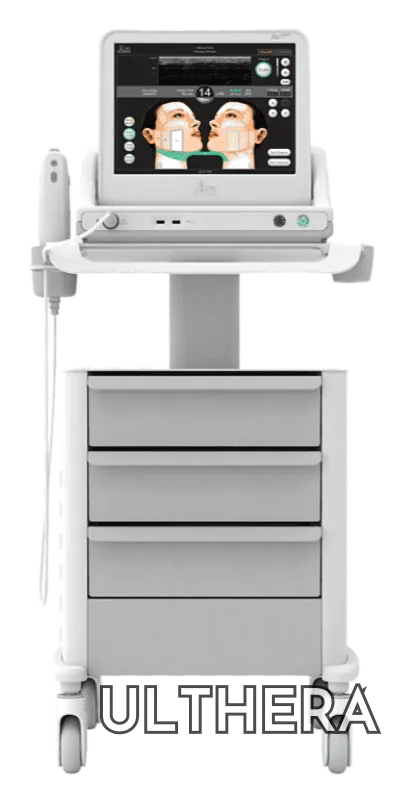
Ulthera
Used for concerns arising from loss of elasticity, such as facial sagging, a blurred jawline, and neck wrinkles. Ultrasound is focused at depths of 1.5, 3.0, and 4.5mm to create thermal coagulation points, and this stimulus prompts collagen in the dermis and fascial layer to reweave, helping improve lifting.
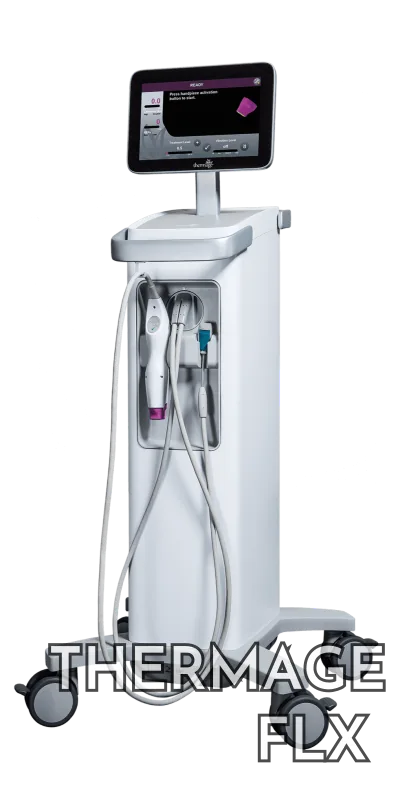
Thermage FLX (4th Generation)
Used for concerns where skin texture and elasticity have declined, such as fine lines on the forehead and around the eyes, lax skin, and enlarged pores. Radiofrequency creates heat in the dermis to contract collagen while the epidermis is protected by cooling, helping improve wrinkles and elasticity.
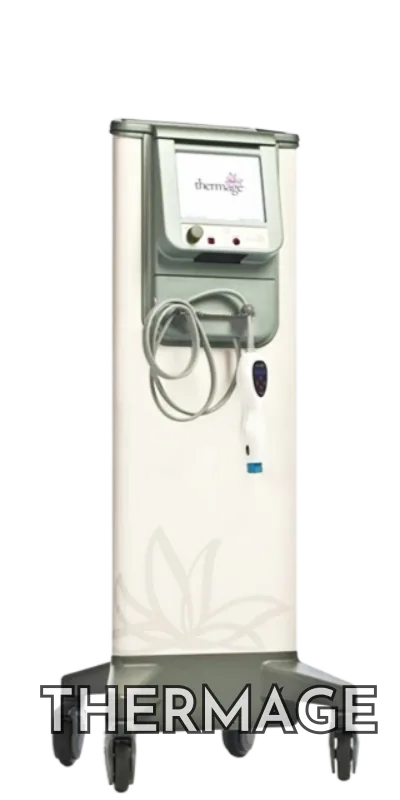
Thermage CPT
Used for concerns of lost facial contour, such as sagging cheeks, a blurred jawline, and drooping eyelids. Radiofrequency delivers heat down to the dermis and fibrous septae, contracting and reorganizing collagen, while alternating cooling and vibration keep discomfort low as it helps improve elasticity.